
If you have been wondering how a supposedly rich country like the UK has become so impoverished, this may help you to understand at least part of the problem.
Back in the 1980s, when the country needed to modernise and set a course for the future, we chose – or rather, we were persuaded – that everything should be left to the market. If it’s worth doing, so the saying goes, then investors will come forward and do it more efficiently than the state can.
There is some truth in that contention. At first, privatisation paid off handsomely. But rather than taking a pragmatic view of what works best, which sectors to privatise and which not to, we have had nearly four decades of ideologically-driven outsourcing and privatisation, fuelled by what at times has been barely concealed greed. We are now paying a high price. To use the vernacular, as a nation we are being royally shafted. Of particular concern to the House of Lords Financial Services committee is the risk lurking in the private equity and private credit banking sectors. The Lords say our nation’s financial stability is at stake.
Those of you who have read past editions of our newsletters will know that we have been banging on about private equity leveraged takeovers of services we all rely on. It’s about paying more, often substantially more, for the dubious privilege of having a service delivered by a company that is sucked dry by its owners to the point of failure, leaving the public sector to pick up the pieces.
This is not an isolated occurrence. It has happened in retirement homes, children’s social care, healthcare, education, armed forces housing, and more. An inevitable – some would argue, deliberate – consequence is that councils end up paying more for outsourced services than when directly operated. Another example is the shambolic failure of the water companies. It’s all part of a bigger picture that is complex and needs some explanation.
To utter even mild criticism of capitalism is to attract hysterical condemnation. So it helps to be able to quote people – not politicians, not theoreticians – but people who have been there, seen it, and done it.
For example, Rachel Wasserman, a seasoned corporate lawyer, former investment banker, M&A dealmaker and now economic reformer, offers a compelling explanation you won’t hear Govt ministers talking about because to do so is to challenge economic orthodoxy. It’s about how modern capital captures, controls, drains cash flow and leaves economies weaker.
“Capitalism has always had its bad actors” says Wasserman on her Substack, “but today’s financial system has evolved into something far more sinister: parasitic capitalism. This economic model allows investors to enrich themselves not by generating new value, but by extracting existing value.” It’s why the rich keep getting richer, productivity feels stuck and living standards seem to be slipping, even for middle and high-income workers. Yet, as Wasserman observes, almost no one is talking about it.
Parasitic capitalism is epitomised by an apex predator, namely private equity leveraged buyouts. This is when the buyer finances a significant portion of the purchase price of a target company with debt and makes that company responsible for repaying the debt. Companies delivering public services and generating large cashflows, and those holding major govt contracts, are favoured targets.
The acquired company not only has to generate a profit for its new owners but also produce sufficient surplus to repay the interest and capital of the sizeable debt, far greater than a company might otherwise need to finance its day-to-day activity. To generate the kind of returns expected in predatory leveraged buyouts the focus switches to financial engineering and extreme profit maximisation. It is not unusual for the ownership of assets to be moved offshore, complex cross billing used to avoid taxation, costs cut to the bone, staff culled, and prices increased.
PE leveraged buyouts have already destroyed consumer sector operations such as Toys R’Us and Sears. The key players in their downfall are invariably American private equity firms such as Blackstone, Carlyle Group and KKR. The latter’s acquisition of Nabisco was the inspiration for the film ‘Barbarians at the Gate’.
This has been driving economic thinking in the US for three generations. It was not inevitable in the UK, we could have set our own course. Instead successive UK governments have forced the public sector to sell assets and outsource services. Private equity leveraged buyouts are just the latest manifestation.
Starting in 1992, Private Finance Initiative (PFI) contracts were used for building and maintaining schools and hospitals. The intention was to keep debt off the government’s books; but these deals have proved punitively expensive, often 40% to 70% more expensive than projects funded through govt borrowing. Parliament and its committees were highly critical of PFI, describing these deals as poor value for money, excessively complex, and a significant long-term risk to public finances. Govt abolished the use of PFI for new projects in 2018.
So it is frightening to learn that the Labour government is exploring renewed use of PFI-style deals to fund NHS infrastructure projects. Critics warn that private finance, in any form, ultimately costs taxpayers more. But with the way Treasury rules work the government has limited options; unless of course, they choose to change the rules. Shock! horror! Cue abject condemnation from the vested interests queuing up to benefit from these skewed deals. Whether it is PFI, or PE leverage buyouts, or the next iteration of global capital’s insatiable appetite, the net effect is to siphon money out of public services and out of the UK economy as a whole.
How the elderly became rich pickings and pet owners were converted to cash cows
It was 35 years ago that central government started to transfer responsibility for social care away from the NHS towards local councils. In principle, it made sense. Local councils should be best placed to meet local need. And ‘care’ is a much broader, less technologically driven brief than ‘health’.
The responsibility was transferred to councils but not the means, i.e. no extra money to invest in premises and staff, because behind the move was an intention to ‘liberate’ care as a business opportunity. It wasn’t long before businessmen were lining up to open care homes. It was a literal bonanza. There were more – and more modern – care homes popping up all over the country, in effect bankrolled by local authorities and by self-funded elderly using the massive increases in housing equity to pay for their care.
Then two things happened. Private Equity operators started to buy up care homes in the UK. Mostly American companies, they had sucked dry the care sector in the USA and were looking to apply their business model in fresh pastures. The second event was the 2008 financial crisis and ensuing austerity, which coincided with increasing bills to local authorities for the care services provided to them by those private equity operators. It couldn’t end well and it hasn’t.
Recently, the Competition & Markets Authority (CMA) finished a two-year-long investigation of the chain operators that now dominate veterinary care for pets. In 2013, roughly 10% of vet practices in the UK were owned by large groups. Today, 60% are controlled by one of six large groups, of which three are private equity operations. The CMA estimates that in the space of five years, pet owners have been overcharged by around £1 billion in fees. The reasons are myriad but come down to a lack of oversight by those supposedly regulating the sector and the inevitable consequences of shifting focus from care to profit. New rules and laws governing the veterinary sector are on the way.
More about the veterinary sector here:
https://theconversation.com/the-problem-with-vet-bills-a-dog-owning-economist-explains-280847
Added since publication: Special Needs Schools
91 new Independent Special schools opened in 2025, the highest annual increase and bringing the total to more than 800. Fees for these schools are mostly paid by the state. However, the cost to a local authority of a privately-operated special school is averagely double that of a state-operated special needs school.
This might explain why local authority SEND budgets are going through the roof and is yet another example of how public services are being hoovered-up by profit hungry operators, of which a growing proportion are owned by private equity.
in 2024 private equity accounted for more than 90% of the total capital invested globally in mergers and acquisitions in the education and training sector, up from 83% the year before, according to investment bank, RL Hulett.
The Times reported in 2025:
Under the Children and Families Act 2014, councils are bound to provide alternative care regardless of cost if space cannot be provided at a government-funded school.
With a dearth of state-run places, private companies have been building schools at a rate of one every five days to meet the need.
Councils paid private firms an estimated £2.2 billion last year, almost double the outlay at the start of the decade. Several councils have said the expenditure has left them at financial breaking point, with projected debts of £8 billion by 2028.
The most profitable operator in the independent special schools sector is the Witherslack Group, according to analysis by LaingBuisson, a business intelligence analyst.
In 2021, it was acquired by a subsidiary of Mubadala Investment Company, a sovereign wealth fund owned by the Abu Dhabi government.
Ultimately owned through corporate entities based in the Cayman Islands and UAE, the company’s profits after tax grew 28 per cent to £44.6 million in 2024 — more than a fifth of its £208 million annual revenue.
Some of the group’s 36 schools were the subject of concern in late 2024 after emergency Ofsted inspections ordered by the Department for Education (DfE).
Water: say no more!
The calamitous state of our water industry has brought private equity leveraged buyouts into stark perspective. All but three of the UK’s water companies are in the hands of private equity operators. The failure to invest, the widespread pollution of rivers and coastal waters, and the potential lack of water supply for homes and businesses in the foreseeable future will go down in history as a monumental failure of government. This has been an object lesson in the dangers of regulatory capture and the failure of market principles.
Successive administrations at Westminster over the past 30 years have ignored the dangers and allowed the parasitic nature of leveraged buyouts to run unchecked. The whole smelly business is still unravelling.
Tale of two tragedies
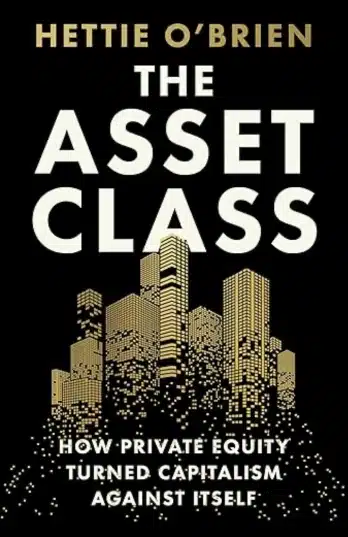
Using her experience as a reporter covering the Federal Trade Commission in Washington DC, Guardian assistant editor Hettie O’Brien has published an acclaimed book and investigation, The Asset Class: How Private Equity Turned Capitalism Against Itself. Her conclusion is chilling: that private equity isn’t just reshaping the economy – it’s selling out the foundations of Western society.